Robotization and employment conflict
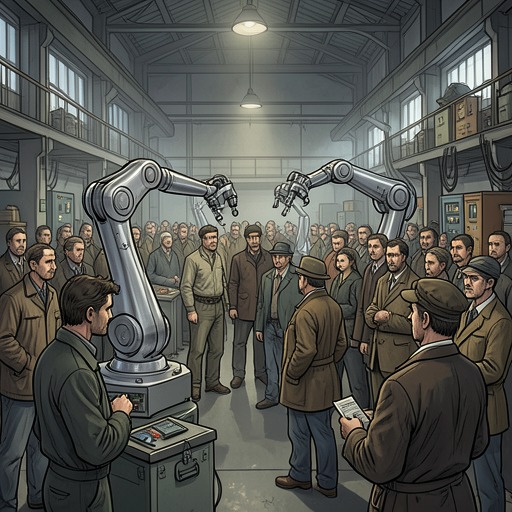
The Caves of SteelRobotization and employment conflict is the social tension produced when robots are presented as efficient substitutes for human labor in a society already organized around dense, highly integrated Cities. The conflict is not merely a dispute over machines: it reaches workers’ livelihoods, their children’s futures, public beliefs about who may be human, and the civic institutions that determine whose interests count. Through rumors, job displacement, and arguments about emigration, the novel makes technological progress inseparable from the question of who bears its consequences.
The City and the promise of efficiency
Earth’s City culture is built around coordination and large-scale distribution. New York City covers more than two thousand square miles and has a population well above twenty million; Earth contains about eight hundred Cities, averaging ten million residents apiece. Each City is economically close to self-sufficient, enclosed within a vast structure of steel and concrete, and organized through residential Sections, expressways and localways, factories, hydroponic plants, yeast vats, and power plants. This planned environment provides the setting in which labor can be reorganized as part of an interconnected system rather than as a collection of separate household tasks.
That organization carries an explicit efficiency argument. City culture favors shared diners and shower rooms over the duplication of kitchens and bathrooms, and its economy depends on food distribution, hydroponics, and yeast production. Robots fit into a culture that values coordinated services and productive systems, but the human cost of substitution is not absorbed by the abstract idea of efficiency. When a machine can perform a worker’s job, the gain to the system may mean lost employment and diminished security for a particular person.
Displacement at work
The conflict becomes concrete in the case of Vincent Barrett, a young worker who has been moved out of his job to make room for K. Sammy. His displacement is not a remote prediction: it is already visible in the workplace, where colleagues discuss the transfer and ask whether Baley can use his influence with the Commissioner on behalf of the young man. Norris acknowledges Barrett’s experience and seniority, yet answers that “a machine with legs can do his work.” The blunt formulation reduces a worker’s claim to a comparison of productive capacity: the machine can occupy the role, so the human worker becomes replaceable.
Barrett’s case also shows why job loss can spread beyond the person directly displaced. He has been pushed aside despite having ten years behind him and a C-3 rating, details that make his situation more than a dispute about an inexperienced newcomer. The workplace talk suggests that service and tenure do not guarantee protection when automation is treated as sufficient justification for replacing a person. Barrett’s appeal is therefore about both immediate employment and the possibility of retaining a place in a system that rates and sorts its citizens.
The conflict extends from the displaced worker to the next generation. During the arrest of Francis Clousarr, R. Daneel asks whether Clousarr fears robots for the sake of his own job. Clousarr answers that he fears for his children’s jobs as well, and for everyone’s children. The exchange widens the stakes: robotization is experienced not simply as a change in the current workforce, but as a threat to the future prospects of families and a whole population. Clousarr’s response turns a personal grievance into a collective one.
Rumor, identity, and anti-robot feeling
Employment anxiety also shapes how people interpret the boundary between human and machine. Barrett tells Baley that rumors claim Lynane Millane, a subethenics dancer, is a robot, and repeats the idea that robots can be made to look human with special plastic skin. Baley dismisses the claim as silly, but the rumor’s presence links fear of replacement to suspicion about identity: if a machine can pass as human, then the threat seems capable of entering ordinary social roles as well as taking work behind the scenes.
The possibility that R. Daneel is a robot is treated as difficult to establish through ordinary observation. Han Fastolfe points out that a humanoid robot might be distinguished by testing rather than by uncertain deductions from speech and manner: one could consider a pin, magnification, irregular breathing, or the absence of detectable blood, pulse, or heartbeat. These proposed checks make the human-machine boundary a practical question of evidence, not merely appearance. In a society already anxious about employment, uncertainty over who is human gives suspicion an additional force.
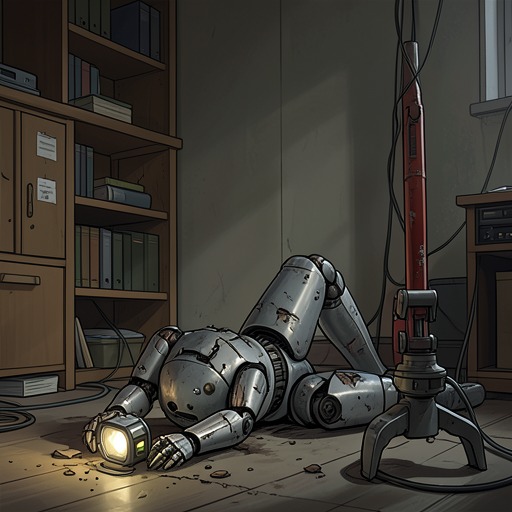
That boundary is also institutional. Baley argues that if R. Daneel identifies himself as a robot, he cannot serve as a witness in an Earth court, because robots have no status there. The point reveals a contradiction central to the conflict: robots may be capable of doing work and taking jobs, yet the legal system does not grant them the standing of human witnesses. Their presence can alter employment and investigation while their testimony remains institutionally excluded. The distinction between productive capacity and civic recognition therefore runs in both directions: people may be displaced by machines that the law does not treat as persons.
Emigration as answer and point of contention
R. Daneel proposes training for emigration as one possible response to job fears, suggesting that Clousarr’s children might prepare to leave Earth. The proposal frames migration as an adjustment to technological change: rather than prevent robots from replacing workers, people might be trained to seek opportunity elsewhere. But Clousarr does not receive this as a neutral solution. He points out that Baley has also spoken about emigration and sarcastically suggests that the policeman may himself be a robot. His reply connects the proposal to the suspicion already surrounding the technology and its advocates.
The exchange leaves a sharp difference between systemic remedy and lived insecurity. For R. Daneel, training and emigration appear as practical possibilities; for Clousarr, the suggestion comes from people who seem aligned with the very force threatening human work. His fear is explicitly familial and broad, while the proposed response asks future workers to adapt by leaving. The evidence does not resolve whether emigration would provide security, but it shows why the suggestion fails to settle the argument: it relocates the burden of adjustment onto those who fear displacement.
Social consequences and significance
The novel presents robotization as a force that reaches beyond the workplace into rumor, status, and political belonging. Barrett’s removal demonstrates immediate displacement; concern for children carries that threat forward; and claims that human-looking robots may be circulating turn economic fear into distrust of appearances. The anxiety is thus cumulative: a worker may lose a position, a family may doubt its children’s prospects, and the public may suspect that machines are already passing within human society.
The surrounding institutional arrangements sharpen that tension. City life depends on planned, large-scale systems, and robots are understood as capable of performing human work; yet human workers remain vulnerable to replacement, and robots lack standing as witnesses in court. The resulting conflict is not simply between a machine and an individual laborer. It is between a system that can treat labor as replaceable capacity and people who understand work as a source of livelihood, status, and a future for their families. By placing the argument in everyday exchanges about Barrett, Clousarr, and emigration, the novel makes technological change visible through its unequal consequences rather than through efficiency alone.